The Benefits and Challenges of a Flat Organizational Structure
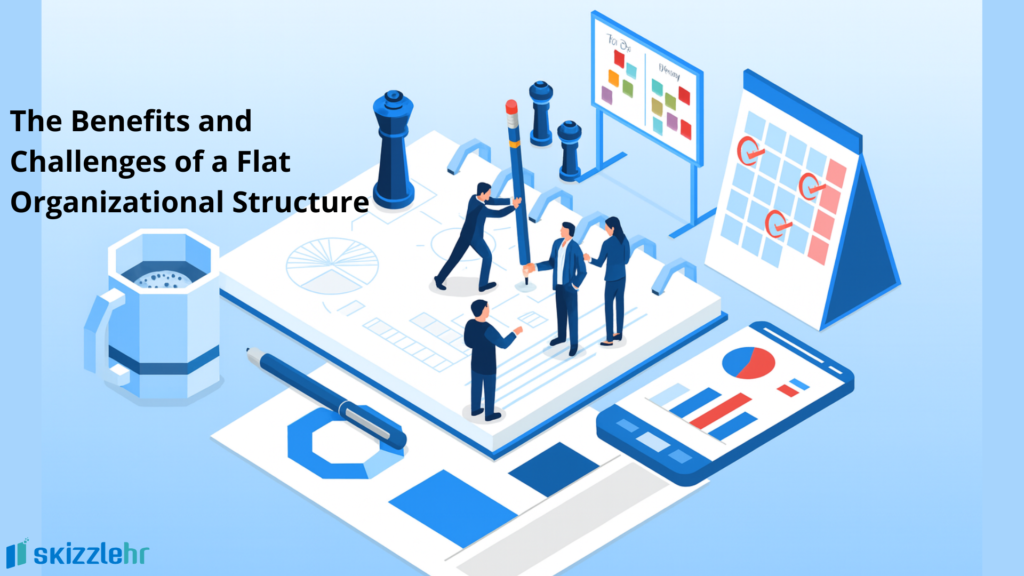
Modern workplaces are evolving rapidly, and with that evolution comes a shift in how businesses are structured. Traditional top-down hierarchies, once considered the norm for smooth functioning, are now being re-evaluated. Increasingly, companies — especially growing and agile ones — are embracing a flat organizational structure, a model where layers of management are minimal, and communication flows directly among individuals across levels.
Among many benefits of flat organizational structure is that it reduces the number of hierarchical levels between leadership and employees, ensuring smoother decision-making, greater agility, and stronger ownership at work. But does this model suit every organization? While the benefits are compelling, the challenges need equal attention. Understanding both sides helps leaders and HR professionals make smarter structural decisions that support productivity, collaboration, and long-term sustainability.
What is a Flat Organizational Structure?
In a flat organizational setup, employees have more autonomy and decision-making power. There are fewer management layers, meaning employees report to fewer supervisors, and teams communicate more openly. This structure encourages faster approvals, quicker problem resolution, and the free flow of ideas across departments.
Startups, creative industries, and tech companies often thrive on this model as it supports innovation, agility, and ownership-led progress. However, scaling it requires strategic planning and effective HR processes to prevent confusion or accountability gaps.
The Benefits of Flat Organizational Structure in HR
HR departments experience several notable advantages when companies adopt a flatter work structure. The biggest benefit is agility — decisions move faster because there’s less hierarchy involved. Employees don’t wait for multiple approvals, enabling quicker execution of tasks and project delivery.
Other advantages include:
1. Faster Communication Flow
With fewer management layers, information is shared more transparently and quickly. HR can streamline policy communication, performance updates, and internal announcements without message distortion or escalation delays.
2. Improved Employee Empowerment and Motivation
A flat organization trusts employees with responsibility and decision-making power. This freedom boosts morale, fosters creativity, and helps individuals feel valued. When roles aren’t restricted by hierarchy, employees take initiative — a strong advantage for innovation-driven teams.
3. Stronger Collaboration Across Teams
Less hierarchy promotes horizontal coordination rather than vertical reporting. Teams collaborate directly with each other, reducing bottlenecks and encouraging knowledge-sharing. HR benefits from improved cross-department synergy, especially when developing policies or implementing cultural changes.
4. Cost Efficiency and Lean Management
Flat structures reduce managerial overhead, enabling companies to allocate resources to strategic areas like learning and development, technology adoption, and compensation planning. For HR, this means more budget flexibility and investment toward employee experience.
5. Employee Visibility and Merit-Based Growth
In a flatter environment, performance becomes more transparent. Employees are recognized for contributions rather than title or seniority. HR teams can build growth paths that reward skills, output, and initiative rather than hierarchical positioning.
Challenges of Implementing a Flat Organizational Structure
While the benefits are significant, a flat structure is not without complexities. One of the biggest concerns is scalability. As employee count increases, decision-making authority can become unclear if responsibilities are not well defined.
Common challenges include:
1. Role Ambiguity
With fewer managers and open hierarchies, employees may struggle with unclear reporting lines or overlapping responsibilities. Without structured workflows, tasks may fall through the cracks.
2. Limited Leadership Development Paths
In traditional structures, managers grow through defined roles. But in flat models, career progression may seem stagnant if upward mobility is limited. This could demotivate employees seeking leadership positions.
3. Risk of Informal Decision-Making
Without clear protocols, decisions may be made informally, based on subjective biases rather than process-driven evaluation. HR may find it difficult to maintain uniformity across employee policies.
4. Communication Overload
Open communication means everyone has access to information, but too much information can be overwhelming. Without structured knowledge distribution, employees may experience decision fatigue.
5. Difficulty in Managing Large Teams
As the company grows, flat structures may become chaotic if systems and tools are not in place. Accountability and performance metrics need defined frameworks to avoid mismanagement.
Where Does HR Tech Fit In?
Whether a company operates with a flat hierarchy or a layered one, efficiency depends on structured processes, transparent access to information, streamlined employee management, and data-driven decisions. This is where modern HR software becomes the backbone of smooth operations.
A platform like SkizzleHR helps organizations manage attendance, payroll, employee records, task delegation, performance tracking, and organization-wide communication — regardless of structure size. With centralized workflows, defined user roles, and automated approvals, businesses can maintain clarity even with fewer reporting layers.
HR software ensures that even in flat setups, performance metrics are consistent, compensation structures are transparent, and internal communication remains organized. For organizations with hierarchical structures, SkizzleHR eliminates manual workload, reduces approval delays, and enables scalability with ease.
Choose Smarter Growth — With Technology Supporting Your Structure
Workplace structure may vary, but operational excellence should not. Whether your organization embraces a flat hierarchy or a multi-layered one, modern HR tools simplify management, empower people, and enhance work efficiency.
SkizzleHR gives teams visibility, clarity, automation, and complete workforce control — so HR can focus on people, not paperwork.
If your company is ready to streamline processes, improve collaboration, and scale confidently,
You might also like



Start Growing with SkizzleHR
Our team is ready to guide you through an interactive demonstration, tailored to your business needs.
Request a demo