What are Payroll Taxes and How to Calculate?
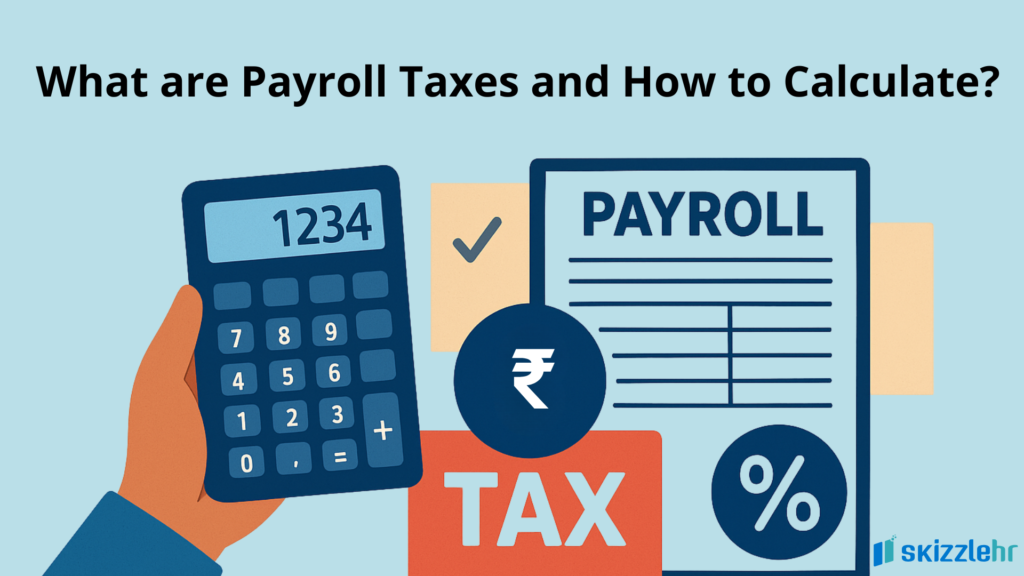
Managing employee salaries goes beyond simply crediting their bank accounts every month. A crucial part of payroll management involves payroll taxes, which ensure compliance with government regulations and smooth financial operations for both employers and employees. For HR managers in small and medium-sized businesses, understanding taxes is vital—not only to avoid penalties but also to build trust and transparency with employees.
In this guide, we’ll break down what payroll taxes are, how they are calculated, and specifically, and what do they include. We’ll also explore how adopting the right HR software can simplify the entire process.
What Are Payroll Taxes?
At their core, payroll taxes are the taxes employers are legally required to withhold from employees’ salaries and remit to the government. These include contributions for social security benefits, healthcare, provident funds, and other statutory compliances. These taxes ensure that employees have access to social safety nets while helping governments collect revenue systematically.

For businesses, proper management of payroll taxes is more than a compliance task—it reflects professionalism and builds a positive employee experience. Mishandling payroll taxes can result in penalties, strained employer-employee relationships, and even legal complications.
What Are Payroll Taxes in India?
For HR managers specifically dealing with Indian compliance, the big question is: What are payroll taxes in India? Simply put, they are the statutory deductions that both employers and employees contribute towards various schemes mandated by Indian law. These include:
- Provident Fund (PF): Contributions towards employee retirement savings.
- Employees’ State Insurance (ESI): A health insurance scheme for workers earning below a certain threshold.
- Professional Tax: Levied by state governments, varying from state to state.
- Labour Welfare Fund (LWF): Contributions made by both employers and employees for the welfare of workers (in applicable states).
- Income Tax (TDS): Deducted based on the employee’s income slab, allowances, and exemptions.
Together, these make up the taxes in India, and compliance is non-negotiable for organizations.
How to Calculate Payroll Taxes in India?
Calculating taxes requires a detailed understanding of various deductions and contributions. Here’s a step-by-step breakdown:
1. Gross Salary Determination
Begin with the employee’s gross salary, which includes basic pay, allowances, bonuses, and other components.
2. Identify Mandatory Contributions
- Provident Fund (PF): Typically, 12% of the employee’s basic salary is contributed by both employer and employee.
- ESI Contributions: 0.75% of the gross salary from employees and 3.25% from employers (if applicable).
- Professional Tax: A fixed monthly amount based on state laws.
3. Apply Tax Deducted at Source (TDS)
TDS is calculated based on the employee’s annual income, investment declarations, and exemptions under the Income Tax Act.
4. Account for Other Deductions
This may include contributions toward gratuity or Labour Welfare Fund where applicable.
5. Net Salary Calculation
Finally, subtract all statutory deductions and taxes from the gross salary to arrive at the employee’s net take-home pay.
Challenges HR Managers Face in Handling Taxes in India
While the steps may sound straightforward, in reality, payroll tax management comes with challenges:
- Changing Regulations: Indian tax laws and contribution rates are updated frequently, making it hard to stay compliant.
- Error-Prone Calculations: Manual spreadsheets increase the risk of incorrect deductions.
- Time-Consuming Approvals: Verifying declarations, calculating TDS, and ensuring compliance often delay payroll cycles.
- Employee Queries: HR teams spend significant time addressing concerns about deductions, tax exemptions, or discrepancies.
For HR managers in small and medium-sized companies, these challenges can consume valuable time that could otherwise be invested in strategic HR initiatives.
Why Automating Payroll Taxes Is a Smarter Choice?
The most efficient way to handle taxes is through automation. Payroll software simplifies calculations, applies real-time compliance rules, and reduces errors. Key benefits include:
- Accuracy: Automated tools apply the latest tax rates and compliance updates.
- Speed: Faster payroll processing ensures timely salary disbursements.
- Transparency: Employees can access payslips with detailed breakdowns anytime.
- Integration: Payroll systems can integrate with attendance and expense tools for seamless operations.
How SkizzleHR Simplifies Payroll Taxes?
For HR managers seeking a reliable solution, SkizzleHR offers an advanced payroll module designed to make managing payroll taxes effortless. Unlike traditional tools, SkizzleHR is built for small and medium-sized businesses that need both compliance accuracy and user-friendly functionality.
Here’s how SkizzleHR stands out:
- Automated Compliance: Stay updated with the latest Indian tax laws, PF, ESI, and state-specific professional tax rules.
- Unified Payroll and HR: SkizzleHR integrates payroll with attendance, leave, and expense management, ensuring accuracy.
- Employee Self-Service: Employees can view their salary breakdown, tax deductions, and payslips directly from the app.
- Scalability: Whether you have 100 or 500 employees, SkizzleHR adapts to your needs without extra complexity.
By reducing manual work and ensuring 100% compliance, SkizzleHR helps HR managers focus on people strategy rather than repetitive calculations.
Conclusion
Understanding and managing payroll taxes is a critical responsibility for every HR manager. From knowing what payroll taxes in India include to calculating contributions and ensuring compliance, the process can be overwhelming without the right tools.
The good news? Technology can make it easier. With the best payroll software like SkizzleHR, businesses can ensure compliance, improve efficiency, and deliver a seamless employee experience. If your goal is accuracy, transparency, and simplicity, SkizzleHR is the partner you need to transform payroll management.
You might also like

Start Growing with SkizzleHR
Our team is ready to guide you through an interactive demonstration, tailored to your business needs.
Request a demo