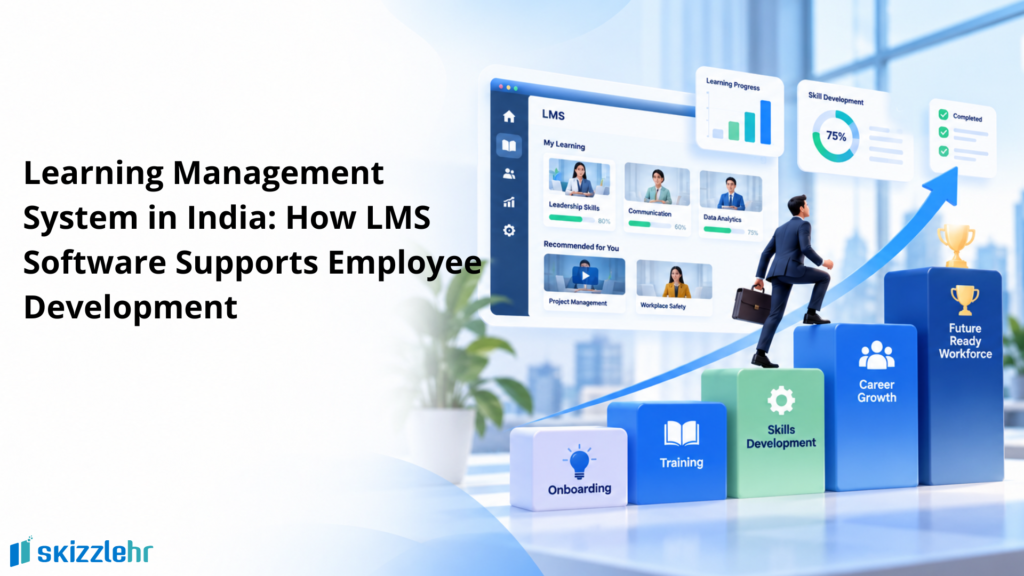
Learning Management System in India: How LMS Software Supports Employee Development
Introduction
Employee development has become an important part of how modern organisations attract, retain, and prepare their workforce. Employees today expect more than a job description and an annual appraisal. They want opportunities to learn new skills, improve their capabilities, take on new responsibilities, and build meaningful career paths.
For organisations, however, managing employee training at scale can become increasingly difficult. Training content may be spread across different platforms, managers may have limited visibility into employee progress, and HR teams can spend considerable time coordinating courses, assessments, attendance, and reports.
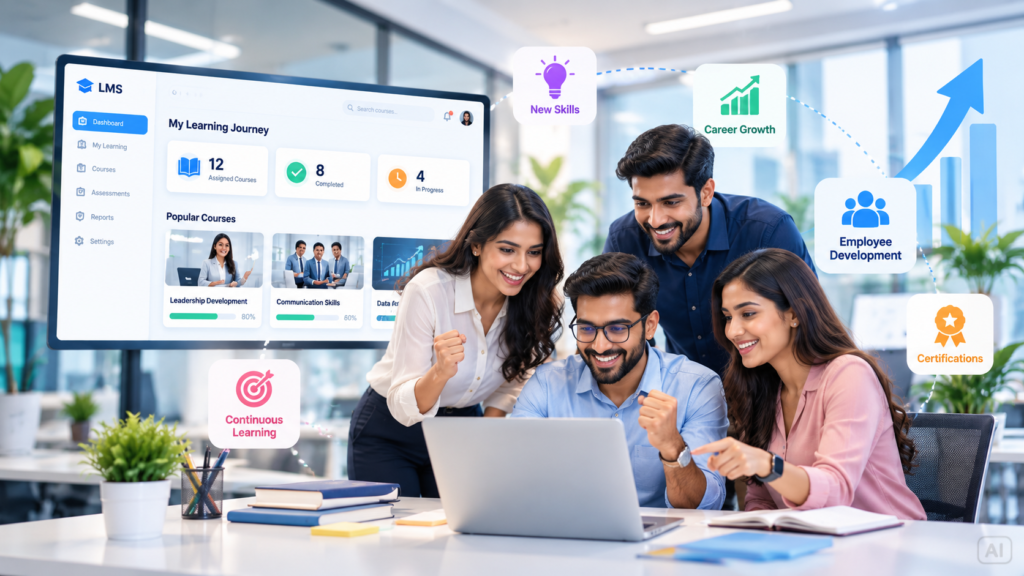
This is where a Learning Management System in India can help.
A modern LMS gives organisations a central platform to manage employee learning, from onboarding and compliance training to upskilling, assessments, and continuous development. It can help HR and L&D teams create more structured learning experiences while giving employees easier access to training resources.
For Indian businesses managing growing teams, hybrid workforces, multiple locations, and changing skill requirements, Learning Management Software can become an important part of a broader employee development strategy.
What Is a Learning Management System in India?
A learning management system, commonly known as an LMS, is software that organisations use to create, manage, deliver, and track learning and training programs.
Instead of managing employee training through separate spreadsheets, emails, shared folders, and manual records, an LMS brings learning activities into one central system.
Depending on the platform, organisations can use an LMS for:
- Employee onboarding
- Employee training
- Compliance learning
- Product training
- Technical training
- Leadership development
- Soft-skills training
- Upskilling and reskilling
- Assessments and quizzes
- Certifications
- Learning paths
- Training reports
- Skills development
The role of an LMS is therefore much broader than simply hosting online courses. It can provide the structure required to manage learning throughout the employee lifecycle.
Why Employee Development Matters for Modern Businesses
Skills requirements are changing rapidly. New technologies, evolving customer expectations, changing business models, and increased use of automation mean that employees often need to learn continuously.
For businesses, this creates an important challenge: how can they make employee learning consistent, accessible, and measurable?
Traditional training methods can work well for specific situations, but they become harder to manage as the workforce grows.
Consider an organisation with employees across several cities. Conducting the same classroom training for every employee may require significant coordination. Employees may also have different learning requirements depending on their roles and experience.
An LMS allows organisations to provide learning in a more structured way while giving employees greater flexibility.
| Employee Development Challenge | How an LMS Can Help |
|---|---|
| Training content is spread across different locations | Centralizes learning resources |
| Difficult to track course completion | Provides digital progress tracking |
| Employees have different learning requirements | Supports role-based learning |
| Manual training administration | Automates several training activities |
| Limited visibility into learning progress | Provides reports and dashboards |
| Training is difficult to scale | Supports learning across larger teams |
| Employees need continuous learning | Provides ongoing access to learning resources |
The objective is not to replace every form of traditional training. Instead, an LMS can complement instructor-led sessions, workshops, mentoring, and on-the-job learning.
How LMS Software Supports Employee Training?
A major benefit of Learning Management Software is that it creates a more organised approach to employee training.
Instead of treating every training program as a separate activity, organisations can build a consistent learning environment.
Centralized Learning Content
Employees may need access to presentations, videos, documents, assessments, recorded sessions, and other learning materials.
When these resources are scattered across email threads, cloud folders, messaging platforms, and different applications, employees may struggle to find the information they need.
An LMS provides a central location for learning content.
HR and L&D teams can organise courses according to departments, roles, topics, or learning requirements. Employees can then access relevant resources without searching through multiple systems.
Structured Learning Programs
Not every employee needs the same training.
A new employee may require onboarding and policy training, while an experienced manager may need leadership development. A sales professional may need product training, while a technical employee may require specialised skills development.
A Corporate Learning Platform can help organisations create learning programs that are more relevant to different employee groups.
This can make training more meaningful because employees are learning skills and information that relate directly to their responsibilities.
Easier Training Administration
Training involves more than creating courses.
HR teams may also need to assign training, communicate deadlines, monitor participation, conduct assessments, maintain records, and prepare reports.
Managing all of this manually can become time-consuming.
An LMS can streamline many of these administrative activities and provide HR teams with a central view of learning activities.
This allows HR professionals to spend less time managing training logistics and more time improving the organisation’s overall learning strategy.
How LMS Software Improves Employee Training?
One of the most important questions businesses ask when evaluating an LMS is how it can actually improve training.
The answer goes beyond convenience.
1. Makes Learning More Accessible
Employees can access digital learning resources without always having to attend a classroom session at a specific location and time.
This can be particularly useful for organisations with:
- Hybrid employees
- Remote teams
- Multiple offices
- Field employees
- Shift-based teams
- Distributed workforces
Greater accessibility can help organisations make learning available to more employees without increasing logistical complexity.
2. Supports Continuous Learning
Employee training should not necessarily end after onboarding.
Employees may need new skills as their responsibilities change. They may also need refresher training or opportunities to develop capabilities for future roles.
An LMS supports this continuous approach by keeping learning resources available beyond individual training sessions.
This helps organisations move from occasional training programs towards a culture of ongoing learning.
3. Provides Better Visibility
One of the challenges with traditional training is knowing what is actually happening after a session is completed.
HR may know that training was conducted, but may not have an easy way to determine who completed it, how employees performed in assessments, or which programs need improvement.
An LMS can provide visibility into learning activity through reports and analytics.
| Metric | What It Can Help HR Understand |
|---|---|
| Course completion | Whether assigned learning has been completed |
| Assessment results | Employee understanding of training content |
| Participation | How actively employees engage with learning |
| Training hours | Time invested in employee learning |
| Certification status | Whether required certifications are complete |
| Course performance | Which learning programs are performing well |
These insights can help HR teams make better decisions about future training programs.
The Role of LMS in Employee Skills Development
Employee development is increasingly connected to skills.
Organisations need to understand not only what employees are doing today but also what capabilities they may need tomorrow.
An LMS can support skills development by providing structured learning opportunities around specific capabilities.
For example, an organisation may provide courses covering communication, leadership, data analysis, project management, customer service, technology, or industry-specific knowledge.
Employees can use these learning opportunities to strengthen their existing capabilities or develop new ones.
For HR teams, this also creates an opportunity to make learning more closely connected with career development.
An employee who wants to move into a managerial position, for instance, may benefit from leadership, communication, delegation, and people-management training. A structured learning platform can make these development opportunities easier to organise and track.
LMS for Different Stages of the Employee Lifecycle
Employee learning can take place at almost every stage of the employee lifecycle.
| Employee Lifecycle Stage | LMS Application |
|---|---|
| Onboarding | Company orientation, policies, role training |
| Early employment | Job-specific and foundational training |
| Ongoing development | Upskilling and professional learning |
| Promotion | Leadership and role-specific development |
| Reskilling | Preparation for new responsibilities |
| Compliance | Mandatory policies and regulatory training |
| Leadership development | Management and leadership programs |
| Career development | Skills and learning aligned with career goals |
This makes a Corporate LMS useful beyond the traditional L&D function.
When connected with broader HR processes, learning can become part of how organisations manage employee growth throughout their careers.
Online Employee Learning for Hybrid and Distributed Workforces
The way people work has changed significantly.
Many organisations now have employees working across different offices, cities, and locations. Some teams work remotely, while others follow hybrid or flexible arrangements.
This makes traditional classroom-only learning more difficult to scale.
Online employee learning gives organisations another way to provide consistent training regardless of where employees work.
Employees can access relevant courses and learning resources through a central platform, while HR teams can maintain greater consistency across locations.
For businesses operating across India, this can be particularly useful when employees need access to the same training content across multiple offices or teams.
LMS vs Traditional Training Management
An LMS does not necessarily mean that businesses have to abandon classroom training or instructor-led sessions.
Instead, it can bring different learning activities together in a more structured environment.
| Traditional Training Management | LMS-Based Training Management |
|---|---|
| Heavy dependence on manual coordination | Centralized training management |
| Training records may be maintained separately | Centralized learning records |
| Limited visibility after training | Progress and assessment tracking |
| Difficult to provide personalised learning | Role-based learning opportunities |
| Reporting can require manual effort | Digital reporting |
| Training resources may be scattered | Centralized content |
| Scaling requires significant coordination | Easier to scale learning programs |
The LMS essentially provides the infrastructure for managing learning more efficiently.
What Features Should Businesses Look for in Learning Management Software?
Choosing the right LMS requires businesses to look beyond a simple feature checklist.
The platform should fit the organisation’s workforce, learning strategy, technology environment, and future requirements.
Some important capabilities include:
Course Management
The LMS should make it easy to organise and manage learning content.
Learning Paths
Structured learning paths can help employees follow training programs relevant to their roles and development goals.
Assessments
Quizzes and assessments can help organisations evaluate employee understanding.
Progress Tracking
HR and managers should be able to see whether employees are completing assigned learning.
Reports and Analytics
Learning data can help organisations understand participation, completion, and performance.
Certifications
Certification management can be useful for compliance and professional development programs.
Integration With HR Systems
Integration with an HRMS can help reduce fragmented employee data and create a more connected HR ecosystem.
Ease of Use
Even a feature-rich LMS may struggle if employees find it difficult to use. Employee experience should therefore be an important part of the selection process.
How to Choose the Best Learning Management System in India for Businesses
There is no universal answer to which platform is the best learning management system in India for businesses.
The right choice depends on the organisation’s workforce size, learning objectives, existing HR technology, training requirements, and budget.
Before selecting an LMS, businesses should ask:
| Consideration | Questions to Ask |
|---|---|
| Business goals | What do we want our learning program to achieve? |
| Workforce | Who will use the platform? |
| Learning content | What types of courses and resources do we need? |
| Personalization | Do different roles require different learning paths? |
| Assessments | Do we need quizzes, tests, or certifications? |
| Reporting | What learning data does HR need? |
| Integration | Can the LMS work with our existing HR systems? |
| User experience | Is the platform simple for employees and HR teams? |
| Scalability | Can it support our future workforce growth? |
| Support | What implementation and support options are available? |
The most suitable platform is one that employees will actually use and HR teams can manage effectively.
How Businesses Can Get More Value From an LMS
Simply purchasing an LMS does not automatically create a learning culture.
Organisations should also think about how learning will be introduced and encouraged.
Here are a few practical approaches:
- Make learning relevant.
Employees are more likely to engage when training is connected to their roles and responsibilities. - Keep learning accessible.
Employees should be able to find relevant courses and resources without unnecessary complexity. - Encourage managers to participate.
Managers can play an important role in encouraging employees to apply what they learn. - Measure more than completion.
Completion rates are useful, but organisations should also look at assessments, participation, skills development, and business outcomes. - Refresh learning content.
Outdated courses can reduce the value of an LMS. Content should evolve with business and employee needs.
Common Use Cases of a Corporate Learning Platform
A Corporate Learning Platform can support different departments and business requirements.
Employee Onboarding
New employees can complete company introductions, policies, role-specific training, and other onboarding requirements in a structured environment.
Compliance Training
Organisations can use learning platforms to distribute mandatory training and monitor completion.
Product Training
Sales and customer-facing employees can access updated product information and training resources.
Leadership Development
Managers and potential leaders can be provided with structured learning around leadership, communication, decision-making, and people management.
Upskilling and Reskilling
Employees can access learning opportunities designed around changing business and technology requirements.
Professional Development
Organisations can support employees who want to strengthen their professional capabilities and prepare for future responsibilities.
Measuring the Effectiveness of Employee Training
A successful learning program should be measurable.
However, organisations should avoid relying exclusively on one metric.
A combination of learning and business indicators can provide a more useful picture.
| Measurement Area | Examples |
|---|---|
| Participation | Enrolments, active learners |
| Completion | Course completion rate |
| Knowledge | Assessment scores |
| Engagement | Learning activity and course participation |
| Skills | Skill development and proficiency |
| Application | Manager feedback and workplace application |
| Business outcomes | Productivity, quality, readiness, internal mobility |
The important question is not simply whether employees completed their courses.
HR leaders should also consider whether the training helped employees perform better, develop new capabilities, or prepare for future responsibilities.
Why SkizzleHR for Employee Learning and Development?
For organisations looking to bring learning and employee development into a broader HR technology environment, SkizzleHR offers an LMS as part of its HRMS platform.
SkizzleHR’s Learning Management System can help businesses manage employee training and development through a centralised platform. HR teams can organise learning, provide employees with access to training resources, conduct assessments, and monitor learning progress.
The advantage of having LMS capabilities within an HRMS is that learning can be managed alongside other employee processes rather than operating as a completely separate system.
For growing organisations, this can provide a more connected approach to managing the employee lifecycle.
Businesses can use SkizzleHR to support areas such as:
- Employee training
- Online learning
- Learning management
- Assessments
- Skills development
- Training management
- Employee development
- Learning progress tracking
- HR reporting
If your organisation is evaluating Learning Management Software for employee development, an integrated approach can help HR teams bring learning closer to the rest of their employee management processes.
Build a Stronger Learning Culture With SkizzleHR
Employee development is no longer something that happens only during an annual training program. As skills evolve and organisations become more dynamic, businesses need to create opportunities for employees to learn continuously.
A Learning Management System in India can give HR and L&D teams the technology they need to organise this process.
From onboarding and compliance training to upskilling, assessments, and career development, LMS software can make employee learning more structured, accessible, and measurable.
The right Employee Training Software can also help organisations reduce administrative effort while giving employees a more consistent learning experience.
Frequently Asked Questions
1. What is a Learning Management System in India?
A Learning Management System in India is software that organisations use to manage employee learning and training. It can support activities such as course management, employee training, assessments, progress tracking, certifications, and learning reports.
2. How does LMS software improve employee training?
LMS software can improve employee training by centralising learning resources, simplifying training administration, supporting structured learning programs, tracking employee progress, and providing data that helps HR teams evaluate learning activities.
3. How can an LMS support employee development?
An LMS can support employee development by providing employees with access to relevant courses, learning paths, assessments, and skills development opportunities. HR teams can also use learning data to monitor participation and progress.
4. What is the difference between LMS and Learning Management Software?
The terms are often used interchangeably. A Learning Management System is the platform used to manage learning, while Learning Management Software broadly describes the software solutions that provide these capabilities.
5. Is online employee learning suitable for Indian businesses?
Yes. Online employee learning can be particularly useful for businesses with hybrid teams, multiple offices, remote employees, and distributed workforces because it provides a consistent way to deliver and manage learning.
Conclusion
Employee development is becoming an ongoing process rather than a one-time training activity.
Businesses need systems that can help employees access relevant learning, develop new skills, and continue building their capabilities as their roles evolve.
A Learning Management System in India provides a structured way to manage this journey. With the right Learning Management Software, organisations can centralise training, support online employee learning, track progress, and gain better visibility into workforce development.
Ultimately, the goal of an LMS is not simply to help employees complete more courses.
It is to help organisations build a workforce that is skilled, adaptable, and prepared for the future.
You might also like

Start Growing with SkizzleHR
Our team is ready to guide you through an interactive demonstration, tailored to your business needs.
Request a demo