Performance Management Software: A Smarter Way to Manage Employee Performance
Introduction
If your company already uses an HRMS, you probably have employee records, attendance, leave, payroll and other HR processes running from one platform.
But there is a good chance that performance management still feels like a separate problem.
Managers may have access to a performance module, yet goals are updated only before appraisal season. Employees may complete self-assessments, but feedback happens months later. HR may have ratings stored in the system, but still spend days chasing managers, reviewing spreadsheets or trying to understand why similar employees received very different ratings.
This is where performance management software needs to go beyond simply digitizing annual appraisals.
Modern performance management is increasingly moving toward continuous feedback, clearer goals, regular check-ins and data-supported conversations. SHRM notes that organizations are moving away from isolated annual reviews toward more ongoing approaches because employees need feedback closer to the work itself.
For businesses that already have an HRMS, the question is therefore not simply “Does our HRMS have performance management?”
The better question is:
“Does our performance system actually help managers and employees improve performance throughout the year?”
What Makes Performance Management Software Different from a Basic HRMS Performance Module?
A basic HRMS performance module may allow HR to create appraisal cycles, assign ratings and store review records.
That is useful, but it is not necessarily enough.
A more capable performance management system connects several stages of the employee-performance journey:
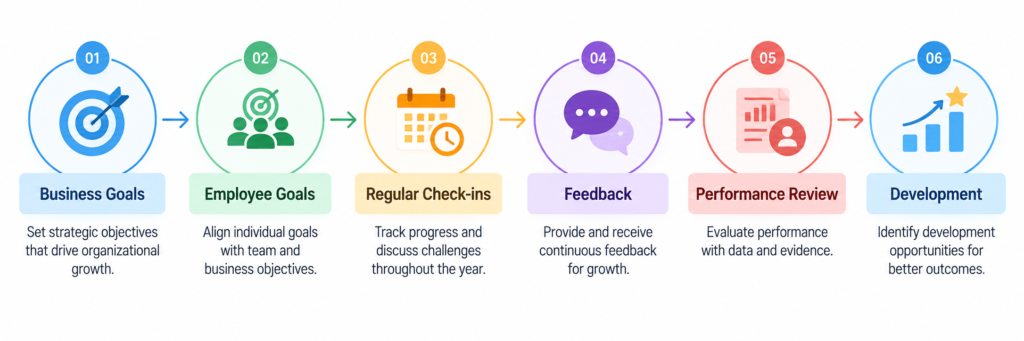 This distinction matters because performance management is not an event that happens once a year. It is an ongoing process of setting expectations, tracking progress, discussing challenges and helping employees improve.
Modern systems can support frameworks such as KRA, KPI, OKR, SMART goals, competency-based assessments and 360-degree feedback, depending on how an organization manages performance. Current Indian software comparisons also increasingly emphasize continuous feedback, goal management, 360-degree reviews and integration with the broader HRMS.
A simple test for your current HRMS
Ask your HR team and managers these five questions:
- Can employees clearly see what they are expected to achieve?
- Can managers provide feedback before the appraisal cycle?
- Can goals be updated when business priorities change?
- Can HR identify performance trends without manually combining reports?
- Can managers use performance data to have better development conversations?
If most answers are “not really,” the issue may not be that you need another HRMS.
You may need better performance management capabilities.
How Performance Appraisal Software Improves Employee Performance?
The value of performance software is not the appraisal form itself. Its value comes from what happens between appraisal cycles.
1. It turns goals into something employees can actually track
Employees perform better when expectations are clear.
Performance management software allows organizations to define goals at different levels and connect individual objectives with team or organizational priorities.
For example:
Company objective: Increase customer retention
↓
Team objective: Improve customer onboarding
↓
Employee goal: Reduce average onboarding completion time by 15%
This gives employees context rather than simply assigning them a list of KRAs.
Depending on the business model, organizations can use OKRs, KRAs, KPIs or SMART goals instead of forcing every department into exactly the same framework.
The important part is visibility: employees should know what they are responsible for, how success is measured and how their work contributes to larger objectives.
2. It replaces “I think they did well” with performance evidence
One of the weaknesses of traditional appraisal processes is recency bias.
A manager may remember a strong project from the previous month more clearly than something that happened six months ago.
A modern performance system can create a record of goals, progress, feedback, achievements and review inputs throughout the cycle.
This does not mean software should make the final judgement about an employee.
Instead, it gives managers better information for making that judgement.
That distinction becomes particularly important as AI enters performance management. SHRM describes emerging AI use cases such as helping managers assess goals, prepare feedback and use performance information more effectively.
3. It makes feedback more timely
Imagine an employee repeatedly missing an important milestone.
With an annual review approach, the conversation may happen months later.
By then, the opportunity to correct the issue has already passed.
With continuous check-ins, managers can discuss the problem while it is still relevant.
The same works for positive feedback. Instead of waiting until the annual appraisal to recognize strong performance, managers can acknowledge achievements when they happen.
This changes performance management from:
Review → Rate → Forget
to:
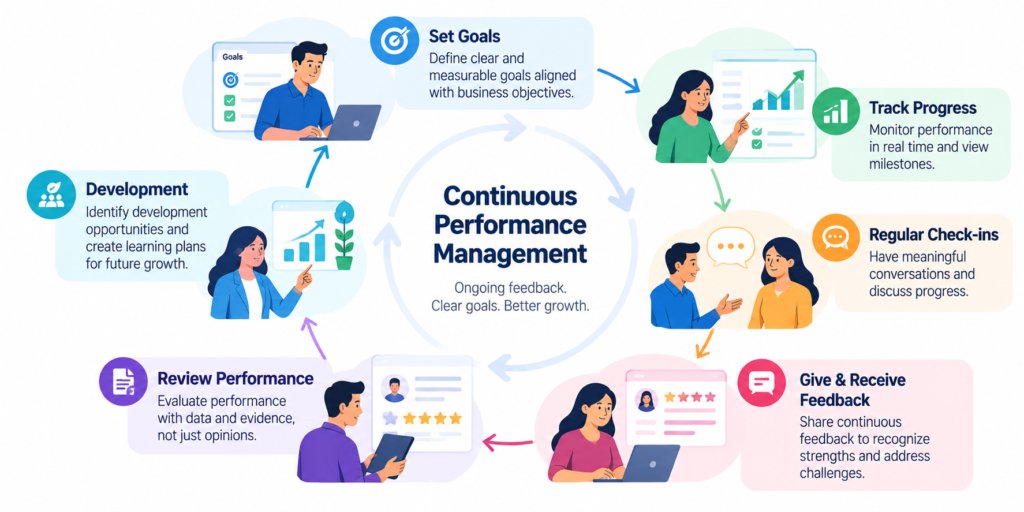
Set goals → Check progress → Discuss → Improve → Review
4. It makes performance conversations more meaningful
A performance review should not feel like an HR form-filling exercise.
The best performance management software gives managers information they can actually use during a conversation.
For example:
- What goals were assigned?
- What has been completed?
- Which goals changed?
- What feedback has been given?
- Where has performance improved?
- What development areas remain?
- What should the employee focus on next?
This gives the manager a starting point for a real conversation rather than a blank rating form.
5. It supports multiple perspectives
A manager should not always be the only person providing performance input.
Depending on the role, organizations may collect feedback from:
- Managers
- Peers
- Team members
- Project leads
- Direct reports
- Employees themselves
This is where 360-degree feedback software can add value.
Instead of treating performance as a single person’s opinion, businesses can collect structured inputs from multiple stakeholders.
However, more feedback does not automatically mean better feedback. Organizations should define who should provide input, what they should evaluate and how that information will be used.
What Should the Best Performance Management Software for Businesses Include?
If you are already using an HRMS, do not evaluate a performance solution simply by counting features.
Evaluate the quality of the performance workflow.
Goal management
Look for flexible support for frameworks such as:
- OKRs
- KRAs
- KPIs
- SMART goals
- Competencies
- Weighted goals
The system should allow organizations to adapt goals as business priorities change.
Continuous feedback and check-ins
Employees should not have to wait until the appraisal cycle to understand how they are performing.
Look for regular check-ins, feedback mechanisms, manager nudges and progress tracking.
360-degree feedback
Useful for organizations where performance depends on collaboration across teams.
Check whether the system supports configurable reviewers, structured questionnaires and appropriate confidentiality settings.
Review and appraisal workflows
The system should handle self-assessments, manager reviews, multi-level approvals, ratings and configurable review cycles without creating unnecessary administrative work.
Performance analytics
HR should be able to identify patterns across teams, departments and review cycles.
Useful analytics may include goal completion, rating distributions, review status, competency performance and appraisal history.
AI-assisted performance management
AI can be useful for supporting—not replacing—managerial judgement.
Potential use cases include:
- Improving goal quality
- Identifying missing or unclear objectives
- Summarizing performance information
- Supporting feedback drafting
- Highlighting performance trends
- Helping managers prepare for review conversations
The key question is not whether a vendor says “AI-powered.”
Ask what the AI actually does and what data it uses.
HRMS and payroll integration
For Indian businesses, this is especially important.
Performance outcomes may eventually influence increments, bonuses, promotions or development decisions.
Connecting performance data with employee records and payroll can reduce duplicate data entry and manual handoffs. Current Indian-market comparisons frequently identify HRMS/payroll integration as an important consideration when evaluating performance systems.
Performance Appraisal Software for Indian Companies: What Should You Check?
Indian organizations often have appraisal processes that are more structured than simply giving employees a yearly rating.
Your performance appraisal software should therefore be configurable around your company’s actual process.
Before choosing one, check:
Can it support different appraisal cycles?
Some organizations conduct annual reviews, while others use quarterly or half-yearly cycles.
Can different departments use different goals?
Sales, HR, finance, engineering and operations rarely measure performance in exactly the same way.
Can ratings be weighted?
For example, an employee’s final evaluation could combine goal achievement, competencies, behavioural factors and manager feedback.
Can appraisal history be retained?
Historical performance data becomes valuable when managers evaluate progression, promotions and development over multiple cycles.
Can performance outcomes connect with compensation processes?
If increments or bonuses depend on ratings, understand exactly how the system handles that workflow.
Is it easy for managers to use?
This is often overlooked. A sophisticated system that managers avoid using will not improve performance.
Where SkizzleHR Fits In
If your organization already has an HRMS but feels that its performance capabilities are too basic, SkizzleHR Performance Management Software is designed to take performance management beyond a once-a-year appraisal process.
SkizzleHR brings goal management, performance reviews, feedback, AI-assisted evaluation and performance insights into the broader HRMS experience.
Build goals around the way your organization works
SkizzleHR supports multiple performance frameworks, including SMART, OKR, KRA, BSC, MBO and 360-degree feedback.
This gives businesses flexibility to structure performance management according to their teams, roles and existing methodology.
Use AI to support performance management
SkizzleHR brings AI into areas of the performance process where it can reduce effort and improve consistency.
AI-assisted capabilities can support goal setting and rating aggregation, helping managers work with performance information more efficiently.
The purpose is not to remove the manager from the process.
It is to give managers better information and reduce repetitive administrative work so they can focus on the actual performance conversation.
Keep performance cycles moving
Performance management often slows down because people forget to update goals, complete reviews or provide feedback.
SkizzleHR includes performance nudges to help keep employees and managers engaged with important activities throughout the performance cycle.
Maintain a longer-term performance picture
An appraisal rating is only one data point.
SkizzleHR helps organizations maintain performance and appraisal history, giving HR and managers greater context when reviewing employee progression over time.
This can be particularly useful when discussing development, promotions, strengths and areas for improvement.
Keep performance connected to HR
If you are already using an HRMS, moving performance into another disconnected system can create another administrative layer.
SkizzleHR’s performance management capabilities work as part of its broader HRMS ecosystem, helping businesses connect performance with their wider employee-management processes.
Should You Replace Your HRMS or Upgrade Your Performance Process?
This is the question many HR teams should ask before starting a software search.
If your existing HRMS handles payroll, attendance, employee records and other core processes well, replacing the entire platform solely because performance management is weak may not always be necessary.
Instead, evaluate where the actual gap exists.
If your current system allows you to record ratings but not manage performance continuously, that is a performance-management problem.
If managers struggle to track goals, provide timely feedback or understand historical performance, that is a performance-management problem.
If HR spends too much time chasing appraisal completion or manually consolidating ratings, that is a performance-management problem.
The right solution should address those gaps without adding unnecessary complexity.
A Practical Way to Evaluate Performance Management Software
Don’t evaluate a product using only a feature checklist.
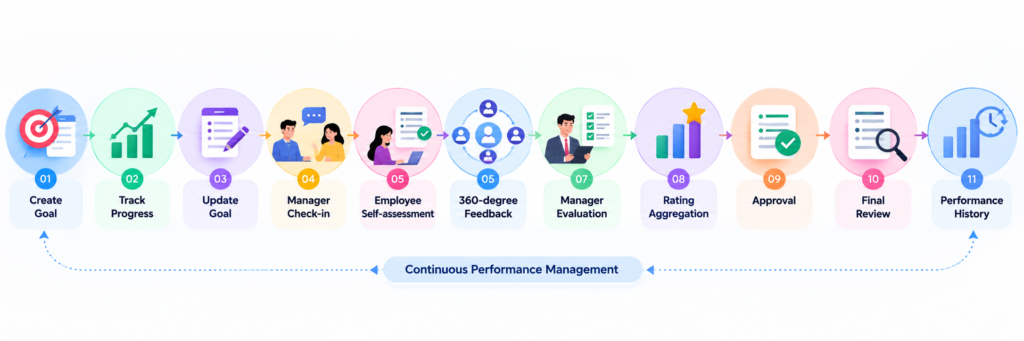
During a vendor demo, give the provider a real employee-performance scenario.
Ask them to demonstrate:
Then ask two simple questions:
“How much of this process is automated?”
and
“What does the manager see before sitting down for the performance conversation?”
Those answers can tell you more about the software’s practical value than dozens of features listed on a product page.
From Annual Appraisal to Continuous Performance
The biggest shift in performance management is not another dashboard or another rating scale.
It is the move from treating performance as an annual HR activity to treating it as an ongoing management process.
- Employees need clear goals.
- Managers need visibility.
- Feedback needs to happen at the right time.
- HR needs reliable performance data.
And organizations need a way to connect individual performance with broader business objectives.
That is where modern performance management software can make a meaningful difference.
If your organization is already using an HRMS but your current performance module feels more like a digital appraisal form than a complete performance process, it may be time to evaluate what a more capable solution can offer.
SkizzleHR brings structured goal management, SMART/OKR/KRA/BSC/MBO frameworks, 360-degree feedback, AI-assisted performance capabilities, rating aggregation, performance nudges and appraisal history into one connected experience.
Instead of asking only, “Did the employee meet expectations?”, modern performance management can help organizations ask a more useful question:
“What can we do throughout the year to help every employee perform better?”
Ready to move beyond basic HRMS appraisals?
Explore SkizzleHR Performance Management Software and schedule a free demo.
Frequently Asked Questions
1. What is performance management software?
Performance management software is a digital solution that helps organizations manage employee goals, performance reviews, continuous feedback, appraisals and performance data in one system. It helps move performance management beyond annual reviews by supporting regular goal tracking, check-ins and development conversations.
2. How does performance management software improve employee performance?
Performance management software helps employees understand their goals, track progress and receive timely feedback. Managers can monitor performance throughout the year, identify areas for improvement and recognize achievements without waiting for the annual appraisal cycle.
3. What features should performance management software include?
Key features include goal management, KPI and KRA tracking, OKRs and SMART goals, continuous feedback, 360-degree feedback, self-assessments, performance reviews, rating management, performance analytics, appraisal history and AI-assisted performance capabilities.
4. How is performance management software different from an HRMS?
An HRMS manages broader employee processes such as employee records, attendance, leave and payroll. Performance management software focuses specifically on managing employee goals, feedback, reviews, development and performance data. A modern HRMS can combine both capabilities in one connected platform.
5. Is performance management software suitable for small and mid-sized businesses?
Yes. Performance management software can help small and mid-sized businesses establish structured goals, standardize performance reviews and maintain performance records as their workforce grows. The right solution should be easy for HR teams and managers to configure and use without adding unnecessary administrative work.
You might also like

Start Growing with SkizzleHR
Our team is ready to guide you through an interactive demonstration, tailored to your business needs.
Request a demo