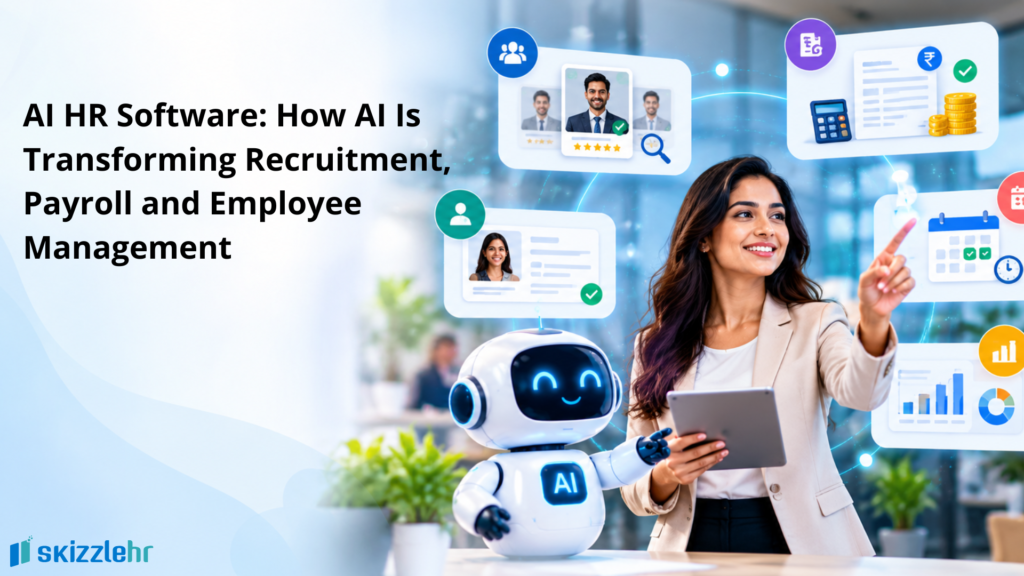
AI HR Software: How AI Is Transforming Recruitment, Payroll and Employee Management
Introduction
Imagine your HR team spending less time answering repetitive employee questions, reviewing routine paperwork, and collecting information from different systems, and more time improving employee experience, supporting managers, and planning for business growth.
That is where AI HR software can make a difference.
As businesses grow, managing recruitment, payroll, attendance, leave, performance, and employee records becomes increasingly complex. Traditional HR processes can involve repetitive administrative work, disconnected information, and delays in accessing the insights managers need.
AI-powered HR software combines artificial intelligence with HR management technology to help organizations automate selected tasks, find relevant information faster, identify workforce patterns, and make better-informed decisions.
For businesses in India, the opportunity is particularly relevant as HR teams manage expanding workforces, multiple locations, changing employee expectations, and increasingly digital operations.
In this guide, we explain what AI HR software is, how it transforms recruitment, payroll, and employee management, what businesses should consider before adopting it, and how SkizzleHR can support a more connected approach to HR operations.
What Is AI HR Software?
AI HR software is a human resource management solution that uses artificial intelligence to assist with HR tasks, interpret workforce information, support selected workflows, and provide relevant insights.
Depending on the platform, it may use machine learning, natural language processing, generative AI, and data analytics to make HR processes more efficient and accessible.
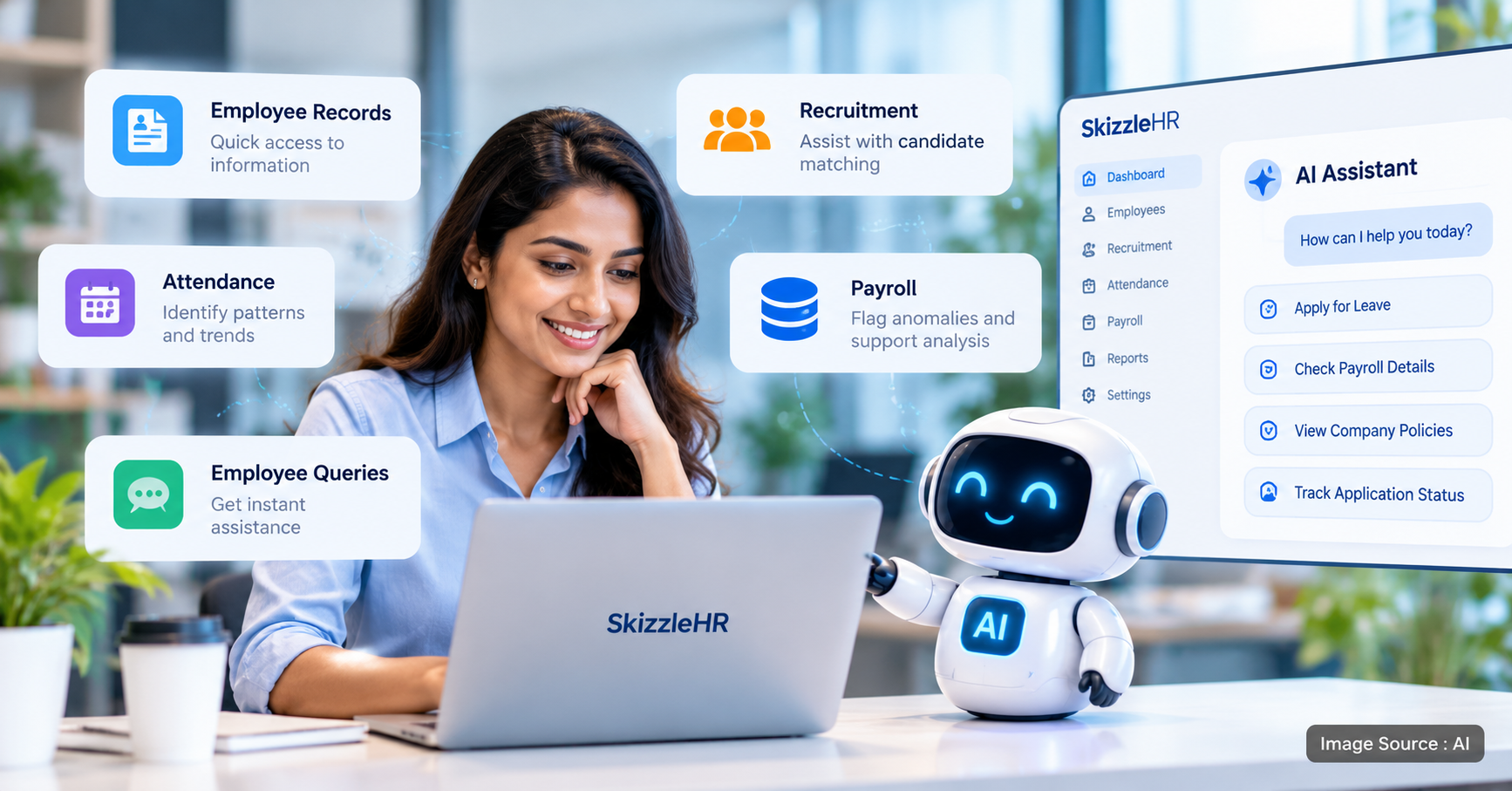
Traditional HR software primarily digitizes activities such as maintaining employee records, tracking attendance, managing leave, and processing payroll. AI-enabled HR software adds another layer of assistance by helping users understand information, interact with HR systems through natural-language questions, or identify patterns in available data.
For example, an employee might ask an AI HR assistant, “How do I apply for leave?” Instead of searching through multiple menus or contacting HR immediately, the employee may receive guidance based on the information available in the system.
The exact capabilities depend on the software, the quality of its data, and the workflows configured by the organization.
What Can AI HR Software Do?
- Recruitment: Assist with resume analysis, candidate matching, and recruitment administration.
- Payroll: Help identify unusual payroll inputs and organize information used in payroll workflows.
- Employee support: Answer routine HR questions using an approved knowledge base.
- HR analytics: Help interpret workforce data and identify trends.
- Performance management: Support goal setting, feedback workflows, and performance analysis.
- HR automation: Reduce repetitive administrative work through configured workflows.
AI does not eliminate the need for HR expertise. Its value comes from helping people perform suitable tasks more efficiently while keeping important decisions under appropriate human supervision.
Traditional HR Software vs. AI HR Software
Understanding the difference helps businesses evaluate whether they need additional capabilities.
| Area | Traditional HR Software | AI-Enabled HR Software |
|---|---|---|
| Employee records | Stores and organizes employee information | May help users retrieve and interpret relevant information |
| Recruitment | Manages applications and recruitment workflows | May assist with candidate matching and application review |
| Payroll | Automates configured payroll calculations and processes | May help flag anomalies or support payroll-related analysis |
| Employee queries | Provides portals, documents, and predefined information | May answer natural-language questions using approved information |
| HR reporting | Generates reports and summaries | May help identify patterns and explain trends in data |
These categories are not mutually exclusive. Modern HRMS platforms may combine conventional automation, reporting, and AI capabilities in the same product.
How AI Is Transforming Recruitment
Recruitment involves more than finding resumes. HR teams must understand role requirements, review applications, coordinate interviews, communicate with candidates, and support fair hiring decisions. AI can help reduce some of the administrative work involved.
1. Faster resume screening
AI-assisted recruitment tools can analyze resumes against predefined job-related criteria, such as relevant skills, qualifications, and experience, and help recruiters identify applications that merit closer review. Recruiters should validate results, check for bias, and consider relevant experience that automated screening may overlook.
2. Better candidate-to-role matching
AI tools may help identify relevant skills across resumes, applications, and other permitted candidate information. This can help recruiters discover transferable skills and potential matches for open roles. The recruiter remains responsible for assessing suitability and making the final decision.
3. Recruitment workflow automation
Scheduling interviews, sending status updates, organizing candidate records, managing recruitment stages, and preparing routine communications can all be automated, reducing repetitive work and making the process more consistent.
4. A more consistent candidate experience
Configured recruitment systems can deliver timely updates and consistent information. AI assistants may answer routine questions when they have access to approved information. Sensitive or complex candidate concerns should still be directed to a responsible recruiter.
How AI Is Transforming Payroll
Payroll is a sensitive business function. Employees expect salaries to be processed correctly and on time, while organizations must manage salary structures, attendance inputs, deductions, and applicable statutory requirements.
Reducing repetitive payroll administration
Payroll preparation may require salary structures, attendance and working hours, approved leave, overtime and shift inputs, bonuses, deductions, and other components. An integrated HRMS can bring these inputs together and automate configured payroll calculations.
Identifying unusual payroll inputs
AI-based anomaly detection may help flag unusual patterns. For example, an employee’s recorded overtime may differ substantially from their usual pattern, and the system may flag it for review before processing. A flagged anomaly does not automatically mean an error has occurred.
Supporting payroll accuracy
Accuracy depends on reliable data, correctly configured rules, validated inputs, and appropriate review procedures. Connected HR systems can reduce duplicate data entry and improve consistency between employee records, attendance, leave, and payroll workflows.
Improving payroll-related employee support
An AI-enabled HR assistant may help employees locate approved information about salary slips, deductions, attendance adjustments, and payroll procedures. Individual salary information must be protected by appropriate authentication and access permissions.
How AI Is Transforming Employee Management
Employee management covers the employee lifecycle, from onboarding and day-to-day HR support to performance management, development, and exit processes. AI can make selected activities more accessible and help HR teams work with workforce information more effectively.
AI-powered employee self-service
An AI assistant can help employees ask questions in natural language about leave, attendance, policies, documents, and HR procedures. Questions requiring policy interpretation, exceptions, or personal intervention should be escalated to HR.
Smarter HR analytics
Analytics can organize attendance, leave, recruitment, workforce composition, and performance information. AI-enabled analytics may help users explore trends or identify patterns that deserve further investigation. Observations should be reviewed in context before action is taken.
Supporting performance management
AI-enabled tools may help draft goals, organize feedback, analyze performance information, and support review workflows. Managers should review and adapt AI-generated objectives and retain responsibility for evaluations.
Supporting learning and development
Depending on the platform, AI can help recommend learning resources, organize development goals, or identify potential skill gaps from appropriate data.
Improving the employee experience
AI assistants, self-service tools, and connected HR workflows can reduce friction in everyday activities, allowing HR professionals to focus on concerns requiring empathy, discretion, and judgment.
Key Benefits of AI HR Software
1. Reduced administrative work
Automating suitable repetitive tasks lets HR teams spend less time on routine processing and more on strategic activities.
2. Faster access to HR information
Natural-language interfaces and connected knowledge resources make it easier to find relevant information.
3. Better workforce visibility
Integrated HR data and analytics help managers understand workforce trends and investigate potential issues.
4. More consistent processes
Configured workflows help standardize routine activities, communications, and approvals across teams.
5. Support for business growth
Connected HR systems help manage growing administrative requirements more systematically.
6. More informed decisions
AI-assisted analysis adds context to HR decisions, provided the underlying data is appropriate and results are reviewed carefully.
💡 Expert Tip:
Start with one or two measurable HR problems. Track the time spent answering routine employee questions or the number of manual steps required to prepare payroll. Establish a baseline before introducing new software so you can evaluate whether the change delivers meaningful value.
| HR Challenge | Possible AI or Automation Support | Human Oversight |
|---|---|---|
| High volume of job applications | Organize applications against defined job criteria | Recruiters evaluate suitability and make hiring decisions |
| Unusual payroll input | Flag discrepancies for investigation | Payroll professionals verify records and calculations |
| Repeated employee questions | Answer routine questions using approved HR information | HR handles sensitive or exceptional cases |
| Attendance trends | Help identify patterns in workforce reports | Managers investigate causes before acting |
| Goal-setting administration | Draft measurable goals and review prompts | Managers validate goals and provide context |
| Finding HR policies | Retrieve relevant documents or policy guidance | HR confirms interpretation where necessary |
Risks and Limitations Businesses Should Understand
Data privacy and security
HR systems contain sensitive information, including employee records, compensation details, and performance data. Understand how information is collected, processed, stored, and accessed, and evaluate security controls and contractual obligations.
Bias in recruitment and performance
AI outputs can reflect limitations or bias in the underlying data and model. Review AI-assisted workflows to ensure people are assessed fairly and on relevant criteria.
Inaccurate or misleading answers
Generative AI can produce incorrect answers or misinterpret context. AI-generated HR guidance should be grounded in approved information, with clear escalation paths for uncertain or sensitive questions.
Overreliance on automation
Decisions involving hiring, discipline, compensation, or performance require appropriate human oversight and consideration of relevant circumstances.
Implementation and employee adoption
Even useful software may fail to deliver value if employees do not understand it or workflows are not configured properly. Provide training, establish clear responsibilities, and review feedback after implementation.
How to Choose the Right AI HR Software for Your Business
1. Identify your main HR challenges
Determine whether your biggest problems involve recruitment administration, payroll processing, employee support, attendance, performance management, or workforce reporting.
2. Verify the actual AI capabilities
Ask the provider to demonstrate specific tasks rather than relying on general claims about artificial intelligence.
3. Check integration with existing HR processes
Review whether the platform connects the functions you use, such as employee records, attendance, leave, payroll, performance, and document management.
4. Evaluate data security and access controls
Ask how the system handles sensitive employee information, restricts access, maintains records, and supports your security requirements.
5. Assess usability
Evaluate the interface, mobile accessibility, onboarding support, and available training.
6. Measure business value
Define metrics before implementation, such as administrative time, processing errors, query resolution, recruitment duration, or user adoption.
7. Request a practical product demo
Ask the provider to demonstrate workflows that reflect your actual business requirements.
How SkizzleHR Helps Businesses Build Smarter HR Operations
SkizzleHR combines AI-assisted capabilities with HR management and workforce administration features in a connected HRMS platform.
For businesses that want to reduce fragmented HR processes, the platform brings together payroll, attendance, leave, employee information, performance management, expenses, documents, assets, learning, and analytics.
Meet Skizzy: AI That Understands HR. SkizzleHR’s AI Co-Pilot, Skizzy, is designed to help users interact with HR information and access relevant guidance through natural-language queries. Its capabilities include contextual understanding and query handling supported by a customized knowledge base related to SkizzleHR’s features.
AI assistance is most useful when it complements well-organized HR processes. Depending on your requirements, explore SkizzleHR’s payroll management software, attendance management system, performance management software, AI Co-Pilot, and broader HRMS platform.
If your organization wants to improve access to HR information, streamline workforce administration, and bring multiple HR processes into a more connected environment, SkizzleHR is worth evaluating against your requirements.
Frequently Asked Questions
What is AI HR software?
AI HR software is a human resource management solution that uses artificial intelligence to support tasks such as information retrieval, workflow assistance, data analysis, and selected HR activities. Its capabilities vary by platform.
How does AI HR software transform recruitment?
AI can help recruiters organize applications, compare candidate information with predefined job requirements, and reduce repetitive recruitment administration. Recruiters should validate results and retain responsibility for hiring decisions.
Can AI HR software automate payroll?
It may support payroll-related workflows by helping identify anomalies or retrieve relevant information. Payroll calculations and statutory requirements depend on correctly configured payroll software, reliable data, and appropriate human review.
What is the difference between AI HR software and HRMS?
An HRMS manages processes such as employee records, payroll, attendance, and leave. AI HR software adds artificial intelligence capabilities to selected workflows. An HRMS can include both traditional automation and AI.
Is AI HR software suitable for small and medium-sized businesses?
Yes. Small and medium-sized businesses may benefit when repetitive HR tasks, employee queries, or disconnected processes create administrative pressure. The right solution depends on workforce size, complexity, budget, and required capabilities.
Is AI HR software safe for employee data?
It can be used responsibly when appropriate security, privacy, access controls, and governance measures are in place. Evaluate how a provider handles sensitive information and ensure AI access follows organizational policies and applicable law.
Can AI replace HR professionals?
AI can assist with repetitive tasks, information retrieval, and analysis, but it does not replace the judgment, empathy, accountability, and contextual understanding required for many HR responsibilities.
Does SkizzleHR offer AI-powered HR capabilities?
Yes. SkizzleHR offers an AI Co-Pilot called Skizzy alongside HRMS capabilities covering payroll, attendance, leave, employee management, performance, and other HR processes. Review the features page and request a demo to understand available functionality.
Conclusion: Build a Smarter HR Function With AI HR Software
AI HR software is changing how organizations approach recruitment, payroll, employee support, and workforce analysis. By combining appropriate automation with accessible information and data-driven insights, businesses can make HR processes more organized and easier to manage.
Successful adoption requires more than choosing a platform with AI features. Organizations need reliable data, suitable workflows, strong privacy controls, human oversight, and clear measures of success.
Ready to simplify HR operations and discover what AI-powered HR management can do for your business?
You might also like

Start Growing with SkizzleHR
Our team is ready to guide you through an interactive demonstration, tailored to your business needs.
Request a demo