What Is Payroll Tax? Definition, Types, and Examples Explained
Introduction
Payroll tax, in simple terms, is money taken from an employee’s wages or given by an employer based on the worker’s salary to fund specific programs like healthcare, retirement and unemployment. Employers can stay legally compliant, fund essential social programs and avoid heavy government fines by managing payroll taxes accurately through a Payroll Software solution. Now you might be wondering, then what is the difference between payroll tax and income tax? Well, payroll tax funds specific social insurance programs and it is split between employees and employers, while income tax is paid by individuals for general government operations. Here in this well-curated blog, we will learn about Payroll taxes, types of Payroll taxes, Payroll tax examples.
Quick Answer:
Payroll Tax at a Glance
- Payroll tax on employee salaries
- Shared by employers & employees
- Includes TDS, EPF, ESIC & Professional Tax
- Funds social security benefits
- Calculated every payroll cycle
- Ensures payroll tax compliance
- Automates payroll tax calculation
- Reduces payroll errors
What Is Payroll Tax?
Payroll Tax Definition
Payroll tax is a tax split between employers and employees and paid directly from company funds based on staff salaries. These funds help and finance the government with social insurance programs such as healthcare and unemployment funds.
Why Payroll Taxes Matter
Employee benefits:
- Income replacement during old age or disability
- Medical coverage support
- Official proof of legal earnings
Government-funded programs
- Employee’s provident fund (EPF)
- Employees’ state insurance (ESI)
Business compliance
- Tax Deducted at Source (TDS)
- Provident Fund (PF)
- Professional Tax (PT)
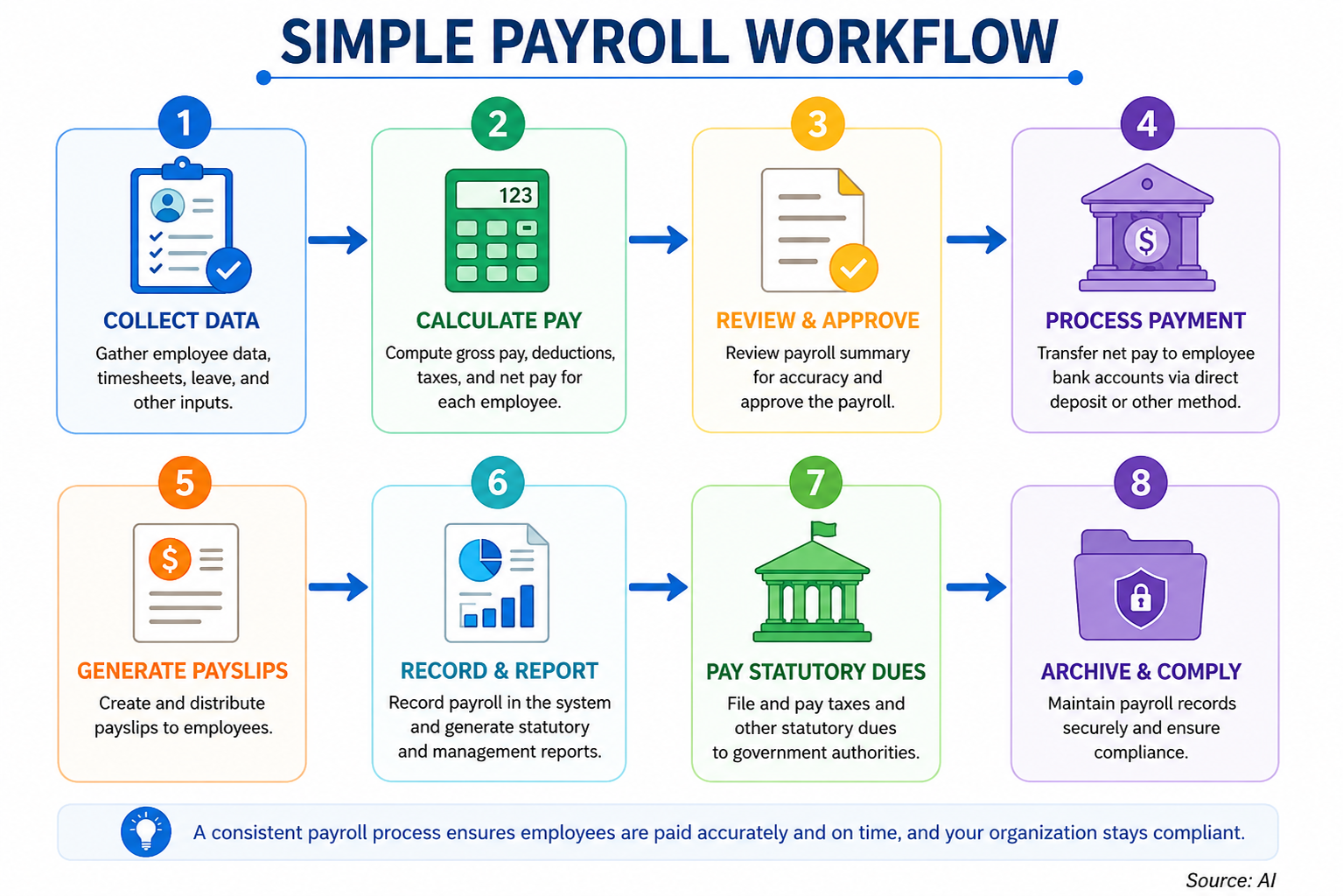
How Payroll Tax Works?
Payroll Tax Process Step-by-Step
1. Employee earns wages
Employees trade their time, skills and labor for money and earn wages through hourly pay, fixed salaries, or piece-rate work.
2.Employer calculates payroll taxes
Employers determine gross pay, withhold employee taxes according to statutory rates and tax tables and contribute matching employer contributions.
3.Required deductions are made
Required deductions are calculated by using government tax tables, employees-submitted forms or legal mandates and remitted directly to relevant authorities.
4.Employer contributes its share
The employer contributes 12% of the employee’s basic salary and dearness allowance.
5.Taxes are deposited with tax authorities
Using electronic online portals, authorized bank branches or direct source deductions, taxes are deposited with tax authorities.
6.Payroll tax returns are filed
By calculating employee withholdings, depositing the funds with the government and submitting periodic compliance forms, tax returns for payroll are filed.
Simple payroll workflow diagram
Types of Payroll Taxes
1. Tax Deducted At Source (TDS)
A system where the sender of payment deducts money early for a set percentage of Tax before giving money to the receiver.
Purpose of TDS: Early Tax Collection, stop tax cheating and steady cashflow
Who Pays:
Employee: As per tax slab
Employer: 0%
Self-employed: Income Tax/Advanced Tax
Learn more at: Income Tax Department – Tax Deducted at Source (TDS) Guide
2.Employee Provident Fund(EPFO):
A mandatory retirement saving scheme where the employee and employer contribute a monthly percentage of worker’s salary which is managed by the Employee’s provident fund organization (EPFO).
Purpose: Retirement corpus, pension & insurance, Emergency support
Who Pays:
Employee: 12%
Employer: 12%
Self-employed: Optional
Learn more at: Employees’ Provident Fund Organisation (EPFO) Official Website
3.Employee’s State Insurance (ESIC):
ESIC is a self-financing social security and health insurance program in India for the well-being of workers managed by Employees’ State Insurance Corporation.
Purpose: Medical care, Sickness Cash Pay, Maternity Leave Pay, Disability & Death Support
Who Pays:
Employee: 0.75%
Employer: 3.25%
Self-employed: Not Applicable
Learn more at: Employees’ State Insurance Corporation (ESIC) Official Portal
4.Professional Tax:
Professional Tax is a direct tax charged by the government of India on income from employment, trade or professions.
Purpose: Fund Local Public Infrastructure, Welfare Schemes, Administrative Services
Who Pays:
Employee: State-specific
Employer: 0%
Self-employed: State-specific (where applicable)
Learn more at: Income Tax Department of India
5.Labour Welfare Fund:
LWF is a state-managed financial pool to improve working and living conditions of workers funded by employees, employers and sometimes state governments with fixed rupee amounts.
Purpose: Healthcare, Education, Housing & Social Security
Who Pays:
Employee: State-specific
Employer: State-specific
Self-employed: Not Applicable
Learn more at: Ministry of Labour & Employment, Government of India
6.Gratuity:
Employers pay a financial lump-sum benefit to an employee as a token of appreciation for long-term service.
Purpose: Financial Security, Reward for continuous, dedicated service
Who Pays:
Employee: 0%
Employer: ~4.81% provision
Self-employed: Not Applicable
Learn more at: Payment of Gratuity Act – Official Guidelines
Employer vs Employee Payroll Taxes
Comparison Table
| Payroll Tax | Employee Pays | Employer Pays |
|---|---|---|
| Tax Deducted At Source (TDS) | ✓ (deducted from salary) | ✓ (deducts and deposits with the government) |
| Employee’s Provident Fund (EPF) | ✓ | ✓ |
| Employees’ State Insurance (ESI) | ✓ | ✓ |
| Professional Tax | ✓ (where applicable) | ✓ (deducts and remits to state government) |
| Labour Welfare Fund (LWF) | ✓ (in applicable states) | ✓ (employer contribution in applicable states) |
| Gratuity | ✗ | ✓ (paid by employer upon eligibility) |
Payroll Tax Examples
Example 1
Small Business with One Employee
For instance, a bakery hires 1 cashier for 3000 Rs. per month. Here the bakery withholds the employee’s social security, Medicare and applicable income taxes from the employee’s paychecks. The bakery also pays its own share of payroll taxes before paying the employee.
Example 2
Company with multiple employees
Imagine an online business expanding to multiple locations and hiring 300 employees remotely from different states. Here, payroll tax calculations become difficult due to different state payroll tax rules. A modern HRMS software automatically calculates taxes for each employee without any errors and saves time.
Example 3
Hourly employee payroll tax example
For example, a retail store employee earns Rs. 20 per hour and works 80 hours in a pay period, which makes his earnings Rs. 2000. Here payroll tax is deducted from employee’s earnings and the employer pays additional payroll taxes separately.
Payroll Tax Deductions Explained
- Tax Deducted at Source (TDS): A system where a person sending payment cuts a small piece of tax directly from the money and sends it to the government.
- Employee Provident Fund (EPF): EPF is a government-backed retirement saving scheme for workers.
- Professional Tax (PT): A direct tax charged by the government of India on income from employment, trade or professions for public infrastructure.
- Employee State Insurance (ESIC): ESIC is a program backed by the government of India for health insurance and social security.
How Payroll Software Like SkizzleHR Simplifies Payroll Tax Management ?
- Automatic payroll tax calculation
- Tax filing assistance
- Compliance alerts
- Payroll reports
- Employee self-service
- Integration with HR and accounting systems
Payroll Tax Best Practices
- Stay updated with tax regulations
- Use automated payroll software
- Conduct payroll audits
- Maintain accurate records
- Verify employee information
- Train HR and payroll teams
- Review payroll reports regularly
Conclusion
Payroll tax calculations and state law compliance are challenging for businesses, which is why it is essential to invest in smart automation tools backed by modern technology to accelerate payroll operations. SkizzleHR is a one-stop solution for all your payroll needs, from employee data setup and attendance tracking to payslip distribution and statutory filing & reporting.
You might also like




Start Growing with SkizzleHR
Our team is ready to guide you through an interactive demonstration, tailored to your business needs.
Request a demo