GPS Attendance Tracking System: How It Helps Businesses Manage a Mobile Workforce
Introduction
There was a time when keeping track of employee attendance was fairly straightforward. Employees came to the office, swiped a card, scanned a fingerprint, or signed a register, and HR had a record of who was present. That doesn’t quite work anymore. Today, an employee’s workplace might be a customer’s office, a construction site, a retail outlet, a hospital, a warehouse, or simply their home. Sales teams spend their days travelling between meetings. Technicians move from one service location to another. Delivery and field-service teams are constantly on the road. Even employees who usually work from an office may occasionally work remotely or visit another branch.
This flexibility is good for businesses and employees, but it has made one everyday HR task a little more complicated: attendance tracking. How does an HR team know whether a field employee has actually started their day? How can a manager keep track of attendance when their team is spread across several locations? And how do you avoid maintaining attendance information through a combination of spreadsheets, phone calls, emails, and WhatsApp messages? A GPS Attendance Tracking System can help answer these questions.
What is a GPS Attendance Tracking System?
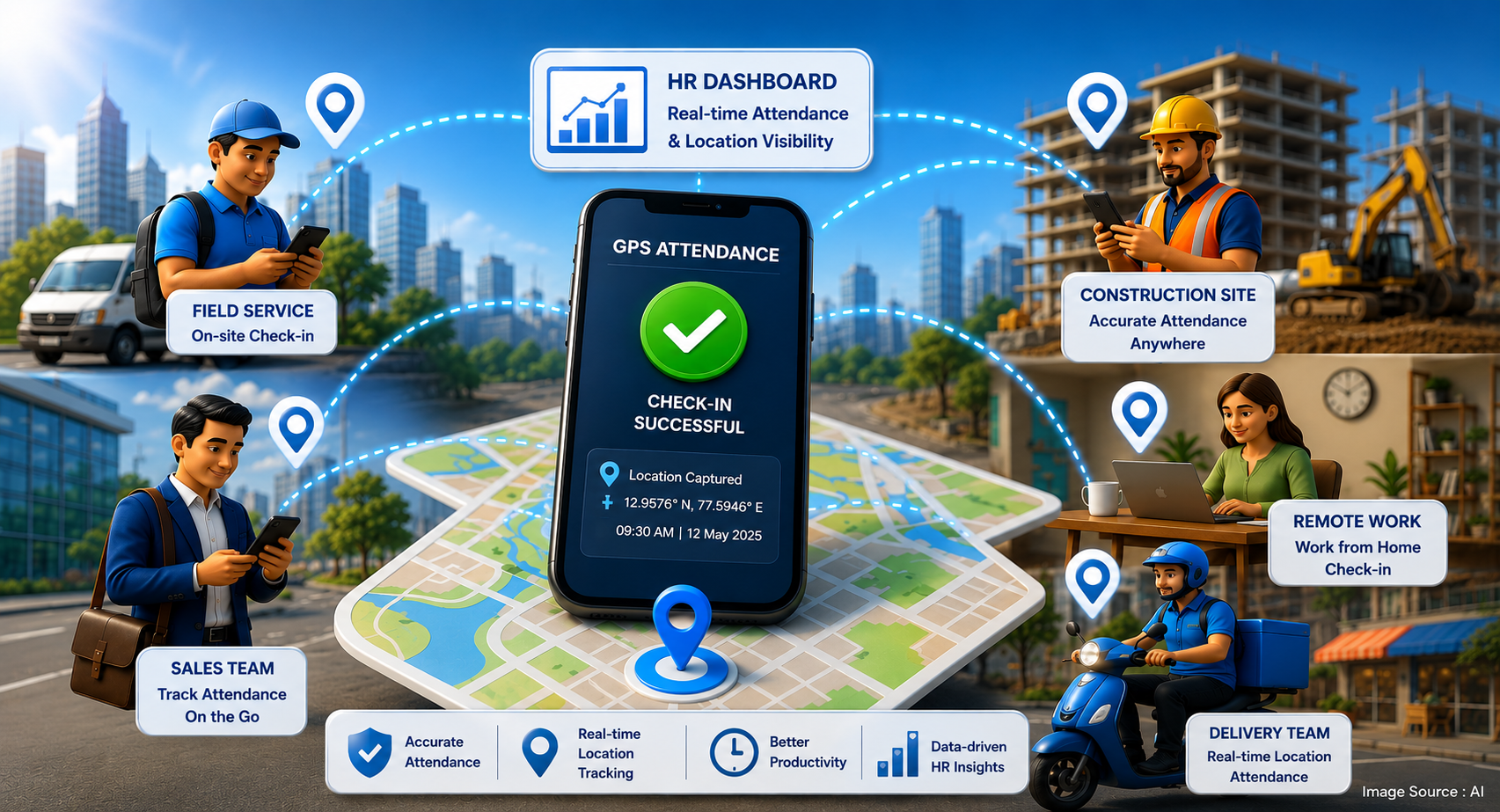
A GPS tracking system is a digital attendance solution that uses GPS or location information when an employee marks attendance through a mobile device. In a conventional attendance system, an employee might simply have a record that says: Present — 9:15 AM For a mobile workforce, that may not tell the whole story. With GPS-enabled attendance, the record can also contain information about the location from which the employee checked in. Depending on the organization’s configuration, businesses can use this information to verify attendance at approved workplaces, customer locations, project sites, or other designated areas.
The important point is that GPS doesn’t replace attendance management. It adds context to attendance. For an employee sitting at a desk in the head office, that additional context may not be particularly important. For a sales representative travelling between customer meetings, a technician visiting service locations, or an employee working remotely, it can make attendance records considerably more useful.
Why Are Businesses Moving Towards GPS-Based Attendance?
The answer is simple: the workplace has become more mobile. Consider a field sales team. Employees may start their day by visiting customers rather than reporting to the office. If the company’s attendance process requires everyone to check in at the office, employees have to make an unnecessary trip just to record attendance. Some organizations work around this by asking employees to send a message when they begin work. Others maintain Excel sheets or rely on managers to confirm attendance.
These solutions can work for a small team. But once the workforce grows, the process becomes increasingly difficult. One employee forgets to send a message. Another has a client meeting outside the city. Someone misses a punch. A manager forgets to update the attendance sheet. HR then has to spend time finding out what happened. A GPS-enabled mobile attendance system can bring these scattered processes into one place. Instead of asking employees to explain where they started their working day, businesses can use a digital attendance process that captures the relevant location information when attendance is marked.
Traditional Attendance vs. GPS Attendance
The difference becomes particularly clear when you compare an office-based attendance system with a GPS-enabled one.
The difference isn’t really about replacing one attendance machine with another. It’s about adapting attendance management to the way employees work.
How Does a GPS Attendance System Work?
For employees, the process can be quite simple. An employee reaches the location where they are beginning work and opens the organization’s mobile attendance application. When they check in, the system captures the relevant location information and records the attendance. Depending on the company’s attendance policy, the system may use location rules or geofencing to determine whether the employee is within an approved area. The basic process looks like this:
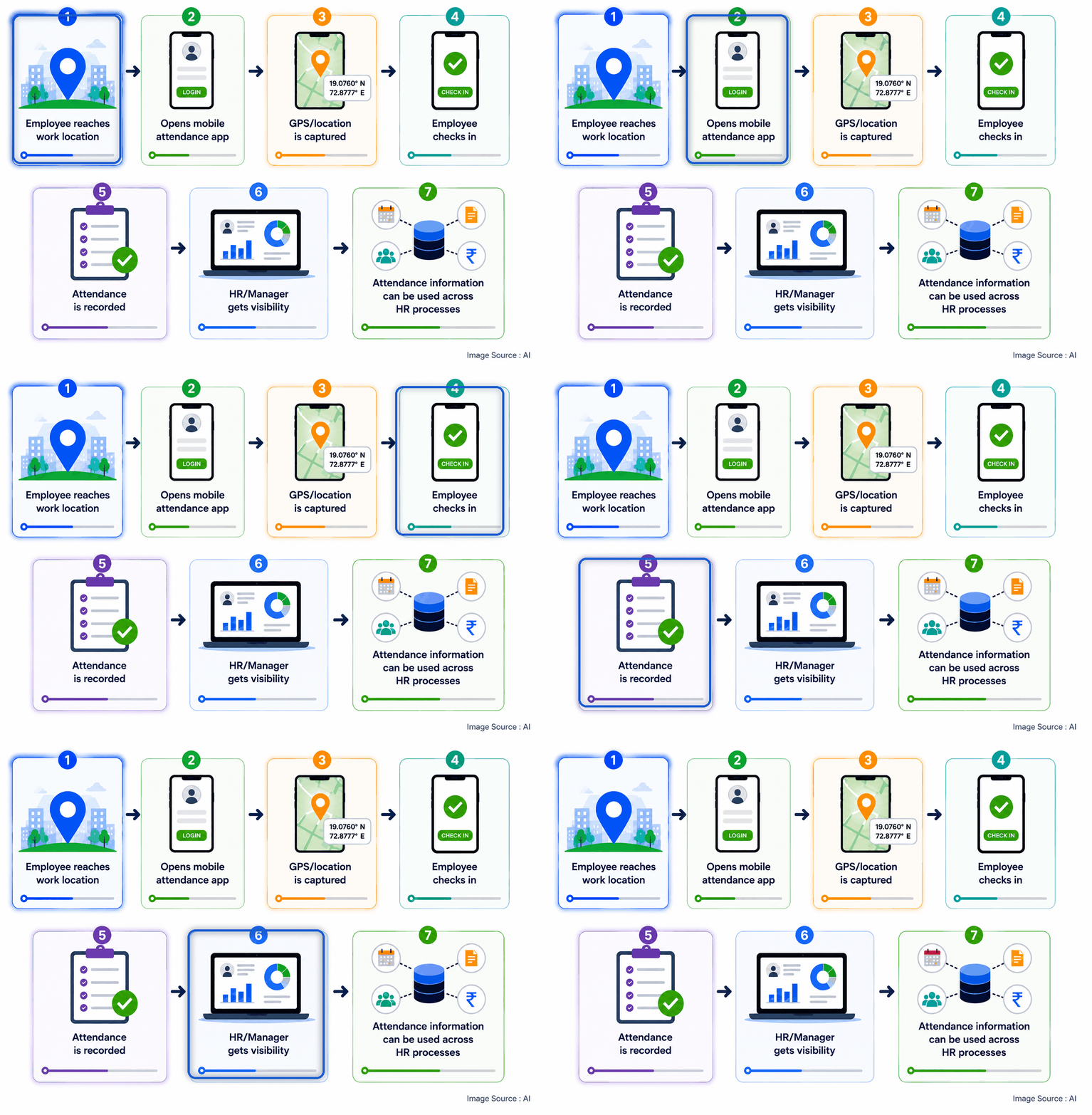 From an employee’s perspective, this can take only a few seconds. For HR, however, the impact can be much bigger because it removes several manual steps that would otherwise happen behind the scenes.
5 Ways GPS Attendance Tracking Helps Businesses
1. It Makes Attendance Easier for Field Employees
For an employee working in an office, marking attendance is usually simple. There is a biometric device, access-control system, or attendance terminal waiting at the entrance. Field employees don’t have the same setup. A sales executive may go directly to a customer’s office in the morning. A technician might reach a service location before ever visiting the company office. A project employee could spend several weeks at a construction site. For these employees, asking them to report to the office simply to mark attendance doesn’t make much sense. A GPS attendance system for field employees gives them a more practical option. They can use their mobile device to record attendance from the location where their work actually begins. This also creates a consistent process for HR. The company doesn’t need one attendance process for office employees and another completely manual process for field employees.
2. It Gives Managers Better VisibilityIntoa Mobile Workforce
Managing a team that isn’t physically together can sometimes feel like managing a team through a collection of messages. A manager may have ten employees working in different locations and have no simple way of knowing who has started their day. That often leads to messages such as: “Have you reached the client?” “Did you mark attendance?” “Are you working from home today?” “Which site are you at?” None of these questions are necessarily unreasonable. But when they have to be asked every day, they take time away from more important work. A GPS Tracking System connected to attendance can provide managers with a centralized view of attendance information. Instead of collecting updates individually, they can access the information through the system. This is particularly useful for organizations with sales, service, logistics, healthcare, construction, and other mobile teams. The goal isn’t for managers to watch employees every minute. It is to give them the information they need without having to constantly ask for it.
3. It Adds Another Layer of Attendance Verification
Attendance can be difficult to verify when employees work outside a fixed workplace. For example, a company may allow field employees to mark attendance through their phones. Without any additional verification, there may be questions about where or when the attendance was actually recorded. GPS provides another layer of information. When an employee checks in, the location associated with the attendance action can be recorded. Organizations can also configure location-based rules or geofencing, where appropriate, to define the areas from which employees are expected to check in. This doesn’t mean GPS will eliminate every attendance issue. People can forget to check in, phones can have location problems, and unusual situations will always occur. What GPS does provide is more information for HR and managers to work with. Instead of having only a “Present” status, they have additional context when reviewing attendance.
4. It Makes Remote and Hybrid Attendance Easier to Manage
The idea of “going to work” has changed. For one employee, it might mean sitting at a company office. For another, it might mean working from home. Someone else could spend the day at a client’s premises. Trying to force all these employees into the same traditional attendance process can create unnecessary complexity. Mobile Attendance Software gives employees a way to record attendance from their phones. When GPS functionality is included, the organization can also capture location information as part of that attendance process, depending on its policies. This can make remote employee attendance easier to administer without creating a completely separate process for every type of worker. For employees, the experience is straightforward. For HR, the advantage is consistency.
5. It Saves HR Administrative Time
This is perhaps one of the biggest benefits, although it isn’t always the first thing people think about when they hear “GPS attendance.” Imagine an HR team managing attendance through spreadsheets, emails, WhatsApp messages, and phone calls. An employee forgets to punch in. Another employee is working from a customer location. Someone else has a missed punch. A manager sends an attendance sheet to HR, but there are a few differences between that sheet and the employee’s records. Now HR has to investigate what happened, contact people, collect confirmations, make corrections, and eventually prepare the attendance information for payroll. Multiply that process by hundreds of employees, and attendance administration can take up a significant amount of time. A centralized attendance platform brings the information into one system. HR can spend less time collecting basic attendance updates and more time looking at exceptions, resolving genuine issues, and focusing on work that actually requires human judgment. That’s where technology can make a difference without making HR feel less human.
GPS Attendance Can Improve More Than Attendance
It’s tempting to look at GPS attendance as a standalone feature. But its real value becomes clearer when it is connected with other HR processes. Consider a company with 100 field employees. Attendance is only one part of managing that workforce. HR may also need to manage their shifts, leave, payroll, employee information, expenses, and other administrative processes. If all of these functions sit in separate systems, HR has to constantly move information from one place to another. An integrated HRMS can reduce that friction. For example, attendance information can become part of the broader employee record and, where the system supports it, connect with leave and payroll processes. That means HR isn’t just collecting attendance. They’re building a more connected view of the workforce.
A Real-World Example: GPS Attendance for Field Employees
Let’s take a simple example. A company has 50 service technicians spread across different cities. Each technician visits customer locations throughout the day. Previously, technicians were expected to send a message to their manager when they started work. At the end of the day, managers consolidated those updates and sent them to HR. It wasn’t necessarily a bad system. It was simply becoming difficult to maintain. As the team grew, missed messages became more common. Managers had to follow up with employees, and HR had to manually update attendance records. After moving to mobile-based GPS attendance, technicians could check in from their assigned work location. The employee didn’t have to send a separate message. The manager didn’t have to maintain a separate spreadsheet. And HR had a centralized attendance record to work with. It’s a relatively small change in the employee’s daily routine, but it can remove a lot of unnecessary administrative work.
What Should You Look for in the Best GPS Attendance Tracking System for Businesses?
Choosing a GPS attendance solution shouldn’t be about finding the app with the most impressive location feature. The better question is: Will this system actually make attendance management easier for our organization? A good solution should be convenient for employees, useful for managers, and manageable for HR. Here are some of the capabilities worth considering:
It’s also worth thinking beyond today’s requirements. A company might initially need GPS attendance for 30 field employees. Two years later, it may have 300. Choosing a platform that can grow with the organization is therefore much more practical than selecting a tool that solves only one immediate problem.
GPS Attendance and Employee Privacy
There is another side of GPS tracking that businesses need to consider: employee trust. When employees hear the words “GPS tracking,” some may immediately assume that their location will be monitored throughout the entire day. That’s not how attendance technology necessarily needs to be used. Businesses should be transparent about what location information is collected, when it is collected, why it is required, and who can access it. They should also establish clear internal policies around the use of location data. For many attendance use cases, the important information is the location associated with the attendance action rather than continuously monitoring an employee’s every movement. The technology should solve a genuine business problem while respecting reasonable employee expectations around privacy. When employees understand why GPS is being used and how it benefits both the organization and the workforce, adoption becomes much easier.
How SkizzleHR Helps Businesses Manage GPS-Based Attendance?
For organizations managing a mobile workforce, GPS attendance is most useful when it is part of a larger HR system rather than a standalone tracking tool. This is where SkizzleHR can help. SkizzleHR combines GPS tracking and mobile attendance with a broader HRMS platform, giving businesses a centralized way to manage employee attendance and other HR processes. With SkizzleHR, employees can use mobile-based attendance while businesses can use GPS capabilities to add location context to attendance records. This can be particularly useful for field employees, sales teams, technicians, remote employees, and teams working across multiple locations. But attendance is only one part of the platform.
SkizzleHR brings together Time & Attendance, GPS Tracking, Leave Management, Shift Management, Payroll, Employee Self-Service, and other HR functions in one connected environment. That means businesses don’t have to use one tool for attendance, another for payroll, and spreadsheets for everything else. For HR teams, this can mean fewer disconnected processes and less time spent moving information from one system to another. For employees, it means having a simpler way to manage everyday HR activities. And for managers, it means having better visibility into the workforce without having to rely on constant messages and manual updates.
From GPS Attendance to Smarter Workforce Management
The future of attendance isn’t simply about replacing a biometric machine with a mobile app. It’s about recognizing that the workplace itself has changed. Employees move between offices, homes, customer locations, project sites, and different cities. HR technology needs to work with that reality rather than forcing everyone into the same traditional process. A GPS Attendance Tracking System can help businesses connect attendance with location, making it easier to manage field employees, remote teams, and distributed workforces. But GPS alone isn’t the answer.
The real value comes when attendance becomes part of a connected HR ecosystem where employee attendance, leave, shifts, payroll, and workforce information can work together. For businesses with a mobile workforce, that can mean fewer spreadsheets, fewer follow-up calls, fewer attendance disputes, and—perhaps most importantly—more time for HR to focus on people rather than paperwork.
Ready to simplify attendance for your mobile workforce?
Explore SkizzleHR’s GPS Tracking and Attendance Management capabilities and see how a connected HRMS can help your business manage attendance, employees, and workforce operations more efficiently.
You might also like



Start Growing with SkizzleHR
Our team is ready to guide you through an interactive demonstration, tailored to your business needs.
Request a demo